Frequently Asked Questions
We know we can’t answer all of your questions without talking to you first, but here are a few of the most common questions we get from our customers.
The 30% federal residential clean energy credit ended for systems placed in service after 2025. Illinois Shines and ComEd programs still offer incentives for solar and storage, and the amounts change each program year.
Yes. A Powerwall can be installed on its own for backup power during outages, or added to new or existing solar so you can store and use more of the power you generate.
Yes. Panels produce less in winter because the days are shorter, but cold, clear days are good for output and snow usually slides off tilted panels. A system is sized on a full year of production, so winter is already counted.
If your roof has only a few years left, replacing it first is usually the better plan. Solar panels stay in place for decades, and removing and reinstalling them later for a new roof adds cost.
Yes. The Village of Schaumburg requires plan review and a building permit before a residential solar system is installed, with electrical and building inspections during and after the work. The installer also needs Illinois Commerce Commission Distributed Generation certification and a village contractor license.
Usually, yes, at install. The price depends on roof size and pitch, the metal profile you choose, any decking repairs, and trim and flashing details. Many homeowners weigh that against the longer life and lower upkeep. Get a free estimate for a price based on your roof.
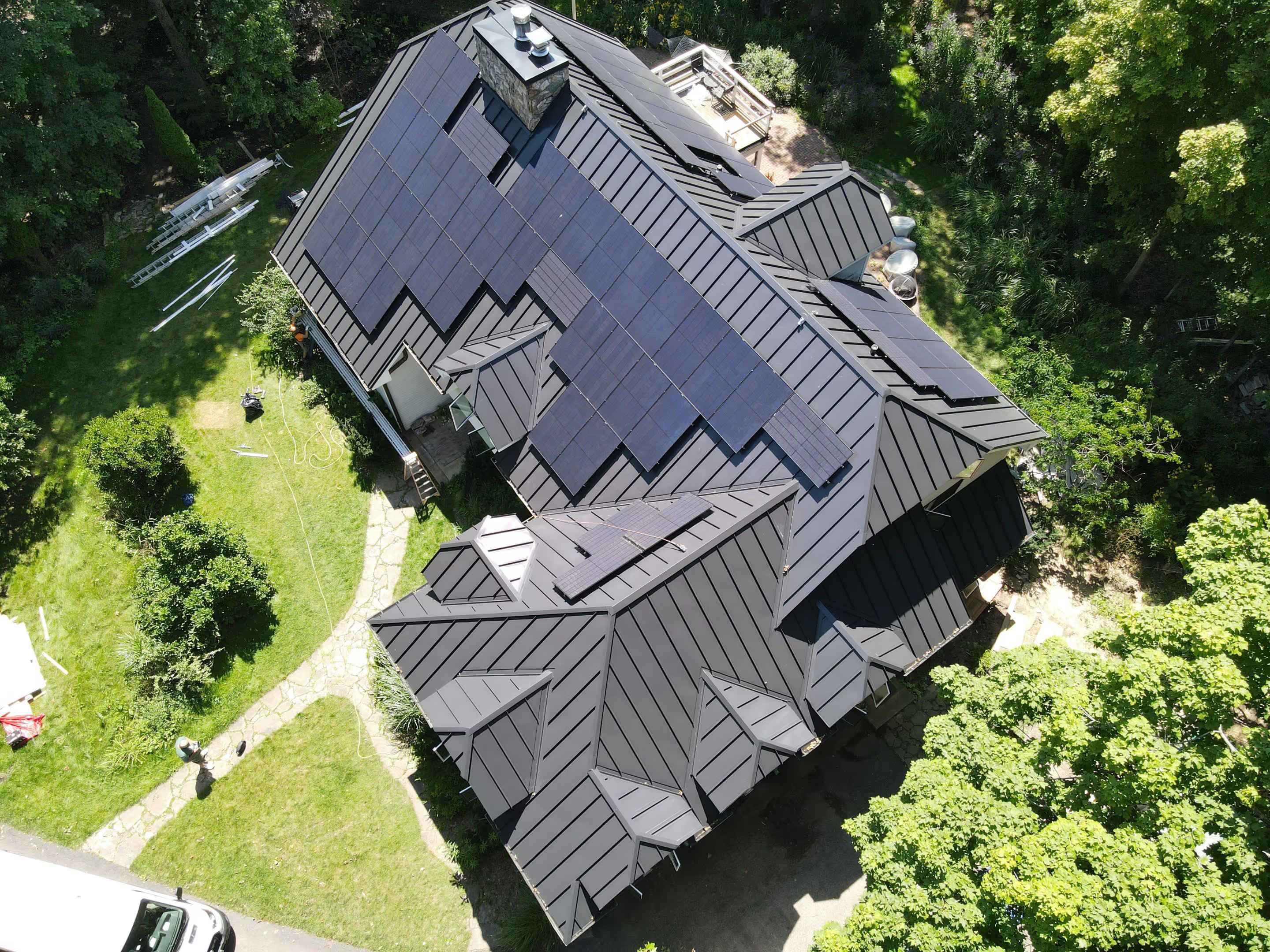
Yes. Standing seam metal is one of the easiest roofs for solar, because panels can be clamped to the raised seams instead of bolted through the roof surface. A long-lasting metal roof also makes it less likely the panels will need removing for a new roof later.
Metal is smooth, so snow tends to slide off rather than build up, which helps limit ice dams at the eaves. Snow guards can be added above doorways and walkways. Good attic insulation and ventilation still matter in Chicago winters.
Not usually. Metal roofs on homes are normally installed over solid roof decking and underlayment, which dampen the sound of rain and hail. Attic insulation reduces it further, so most homeowners notice little difference from shingles.
A metal roof usually lasts much longer than an asphalt shingle roof. How long yours lasts depends on the panel type, the metal and its coating, and how well it is installed and ventilated. The manufacturer’s warranty for the product you choose sets out what is covered and for how long.
Make sure everyone is safe, take photos of any damage you can see from the ground, and stay off the roof. Then call us for an inspection. If water is getting in, we can tarp the roof or make emergency repairs to stop further damage.
It depends on your policy. Most insurers set a time limit after a storm, so check your policy and book an inspection soon after the storm passes.
Many policies cover sudden damage from hail and wind, but coverage depends on your policy and deductible. We can help you document the damage, file your claim and work with your insurance company.
Yes. We inspect your roof at no cost and walk you through what we find, so you can decide on the next step.
Look for missing or cracked shingles, dents on metal roofing or bruising on asphalt shingles, water stains on your ceilings or walls, and gutters clogged with storm debris. Some hail damage is hard to see from the ground, so a close roof inspection is the safest way to know.
Yes, as part of a home solar or battery install. We add EV chargers for homes only, alongside solar panels or a battery, not as a separate job and not for businesses.
Yes. We install home batteries on their own as well as with solar panels, for example in homes that lose power often. Solar panels can be added later.
Yes. We repair solar systems we installed and systems other companies installed, including ones whose installer has closed.
Most of our customers do: nearly every solar system we install includes a battery. Without one, the power your panels make that you do not use right away goes back to the grid. With one, you keep it for the evening and for outages. A home battery can also be installed on its own or added after the panels.
If your roof has less than ten years left, panels put on it now will have to come off and go back on when the roof is replaced, and you pay for that work. Our roofers and solar crew can show up at the same time, so a new roof and the panel racking go on as one project. If you already have panels and need a new roof, we take them off and put them back.
Landmark PWR is CertainTeed's integrated solar roof. Each solar shingle is rated at 85 watts and uses half-cut monocrystalline cells with 21.1% cell efficiency. The solar shingles are built into the roofline, and the rest of the roof is finished around them. It is available from November 1, 2026.
A solar roof is part of the roof itself, so it makes the most sense when your roof is due for replacement or you are building new. If your roof still has years left, solar panels on the existing roof are usually the simpler choice, and we install those too. If you already have panels and need a new roof, we can take them off and put them back.
Yes. CertainTeed designed Landmark PWR so a single solar shingle can be removed and replaced. Our roofers and electricians both work for Phoenix, so one company handles the roofing and the electrical side of the job.
CertainTeed backs Landmark PWR with a 25 year limited power warranty, a 25 year limited workmanship warranty and a 10 year limited wind warranty for winds up to 110 mph. The power warranty guarantees 98% of rated output in the first year, with output dropping no more than 0.55% a year through year 25. Your quote includes the warranty terms for your system.
The roof needs a pitch of at least 4:12, which rules out low slope roofs. Beyond that it comes down to which way the roof faces, shade and your electrical panel. We check all of that at the free visit before we quote.
Often, when hail or wind caused the damage. We inspect, document the damage and work with your carrier. Your coverage depends on your policy.
Yes. Doing both together means one crew, one schedule and one point of contact, and after a storm it often means one insurance claim.
Most homes take a few days once materials arrive. We give you a schedule with your estimate.
For most homes, yes. Fiber cement handles freeze and thaw cycles, hail and humidity better than vinyl or wood, and it does not rot or need regular staining.
It depends on your energy usage and the number of Powerwalls installed. Each unit stores approximately 13.5 kWh of energy, and usage levels will determine how long backup power lasts.
In some cases, yes. A properly sized solar and battery system can significantly reduce or eliminate reliance on the grid, though most homes remain grid-connected for flexibility and reliability.
Powerwall can back up essential systems or even an entire home depending on system size. This can include lighting, appliances, HVAC systems, and even EV charging in some cases.
Tesla Powerwall is a home battery system that stores energy for later use. It allows homeowners to use solar energy at night, during outages, or when electricity rates are highest.
Though it is not necessary to have a battery, it’s wiser to pair your solar panels with one. Adding battery storage to your home solar system lets you store the excess energy your solar panels produce. With a battery, you can save your renewable energy and use it at night or in an outage instead of drawing electricity from the power grid. Some areas provide rebates for battery storage.
Solar does increase the value of your home. Studies from Zillow have shown that property values tend to increase by an average of 4.1%. Prospective homeowners are also more likely to buy a home with solar than without solar panels. Solar is becoming more and more attractive to buyers especially as energy bills are on the rise. Especially when buying a house, any cost-saving measures can be invaluable in the long run. Another study by the Lawrence Berkeley National Laboratory concludes that each kW of solar installed can raise your home value by $5,000. Our average residential solar system is 10kW, raising home value by an estimated $50,000.
Solar lets your home make its own electricity instead of buying all of it from the utility. There are several reasons homeowners consider it. It could seem unnecessary or cumbersome, but there are plenty of reasons why you should consider solar for your home. One of them is how much money this saves you! Solar energy from the sun is free and is a renewable resource so you never run out of power. Whereas, utility companies use finite resources for energy such as coal and natural gas that have to be generated for power. By going solar, you can reduce energy bills by a significant percentage. Most energy companies are also raising their prices as we run out of finite resources and their mistakes cost us money! Additionally, solar is the cheapest form of energy in the world today.
Solar batteries are essential for maximizing the benefits of solar energy. They store excess energy for later use, providing a consistent power supply even when solar panels are not actively producing electricity. This helps reduce reliance on the grid and can save money by avoiding peak electricity rates.
This is a great question as you invest in a new roof for your home. You want to know how long your investment will last in terms of roof lifespan. The lifespan tends to depend on the types of materials used for your roof. A standard asphalt roof will tend to last about 25 years; however, around the 20-year mark is when you should start considering roof replacements. Premature roof failure is another reason to look into roof replacement. Improper roof installation and inadequate attic ventilation are two reasons your roof could fail prematurely. Finally, weather damage is another reason to have your roof replaced. If you live in a heavy weather area, your home might need more replacing than the average roof lifespan. You can always schedule a consultation with Phoenix Exteriors to determine what would work best for your home!
Here is a list of some common reasons you would need to replace your roof:
Damage due to water, weather, or wildlife
Your ceiling is sagging, has dark streaks on the roof or shingles, or light shining through roof boards
Decayed, missing, curled, or broken shingles
Missing granules on shingles
Age of roof (20 year mark is a good time to start thinking about a new roof)
Visible moss
Chimney flashing damaged
Poor attic ventilation
All the seasons have their pros and cons, but a big factor at play here is where your home is located. Some would argue that the summer season is the best time of year to have your project scheduled, but the extreme heat could make it hard for the crew to complete the project. Additionally, summer is usually the busiest time of year for the roofing industry so availability could be limited. Spring is also a popular season to schedule due to availability being a little more flexible and temperatures in most areas do not scale on the extreme side; however, some areas in the US are quite wet during this time, so it would be much harder to schedule. Fall is also a preferred time to schedule a roof installation. It tends to be on the cooler side without being too cold for other operational problems and less busy during the fall season too. Arguably, winter is the worst time to have your roof replaced. If there is an emergency, you might not have much of a choice, but the good news is that winter is usually the most available time for roofing crews to complete a project. Winter is a bad time for installations due to a few different reasons: roofing materials harden and become brittle, shingles could crack, shingles take longer to adhere than in warmer temperatures, and sealants wouldn’t be applied as effectively. Shingles can only be installed in 40-45 degrees Fahrenheit, some shingles allow for as low as 32F for installation. So really the best time to replace your roof is up to you!
Net metering is how your utility credits you for the solar power you send back to the grid. The rules are set by your utility and your state, and they change: some utilities now credit the power you send back at less than what they charge you for power, which makes storing it in a battery for the evening worth more. Your quote is built on your utility's current rules.
Roof replacement costs can vary due to a variety of factors. Some of those factors include square footage, materials, labor, where the home is located, the layers of the roof, the teardown, environmental conditions, the extent of roof damage, and finally roof design. The square footage, materials, labor, and roof design are all pretty self-explanatory. We do charge based on the square footage of the roof so we know how much to charge for the material and if the design of the roof is more of a challenge, we also will be required to take extra safety precautions for our installation crew. Additionally, if your roof has any rotting wood, this also adds to the difficulty and safety of the project. Pricing a roof replacement can seem daunting, but if you get in touch with us, we can get you a complimentary roof estimate hassle-free.
We quote every home on its own, because the price depends on the size of the system, your roof, your electrical panel and whether you add a battery. Incentives depend on your state and your utility, so they are worked into the quote as well. For a first number, enter your address in our solar estimate tool. It shows a system size and a monthly figure in a couple of minutes.
Roof replacements can vary especially since there is planning done well before the installation. If we are only talking about installation time, after permits have been approved locally, we schedule a good time that works for the client. Once scheduled and as long as the weather permits, a roof replacement installation could take anywhere from 1-5 days. Different factors play a part in the timeline of an installation. Accessibility of your roof contributes to how the installation crew will be able to conduct the tasks and if the roof is of a particular design that can add some time. The design of your roof, tear down, and cleanup of the site all contribute to the process.
Yes, solar can save you money! When you switch to solar, you are cutting back and in some cases cutting out your energy bill altogether! However, you will always be getting an energy bill for connection fees to the grid. On average, American households spend about $1,500 in electricity bills a year. This number is also likely to increase as utility companies continue to raise their prices as finite resources run out. Solar, however, is an infinite resource that we can harness for a cleaner world and solar will only help you save money!
In many places, there are government incentives, rebates, or tax credits for installing solar panels and energy storage systems, including solar batteries. Get in contact with us to learn about available incentives in your area.
Get a Free Inspection
No money down, flexible terms, & low monthly payments
Wondering If We Have the Expertise You're Looking For?
Discover the Phoenix Difference
Phoenix Exteriors is dedicated to creating a brighter future by combining roofing and solar expertise with a commitment to sustainability, delivering exceptional service while reducing our environmental footprint.